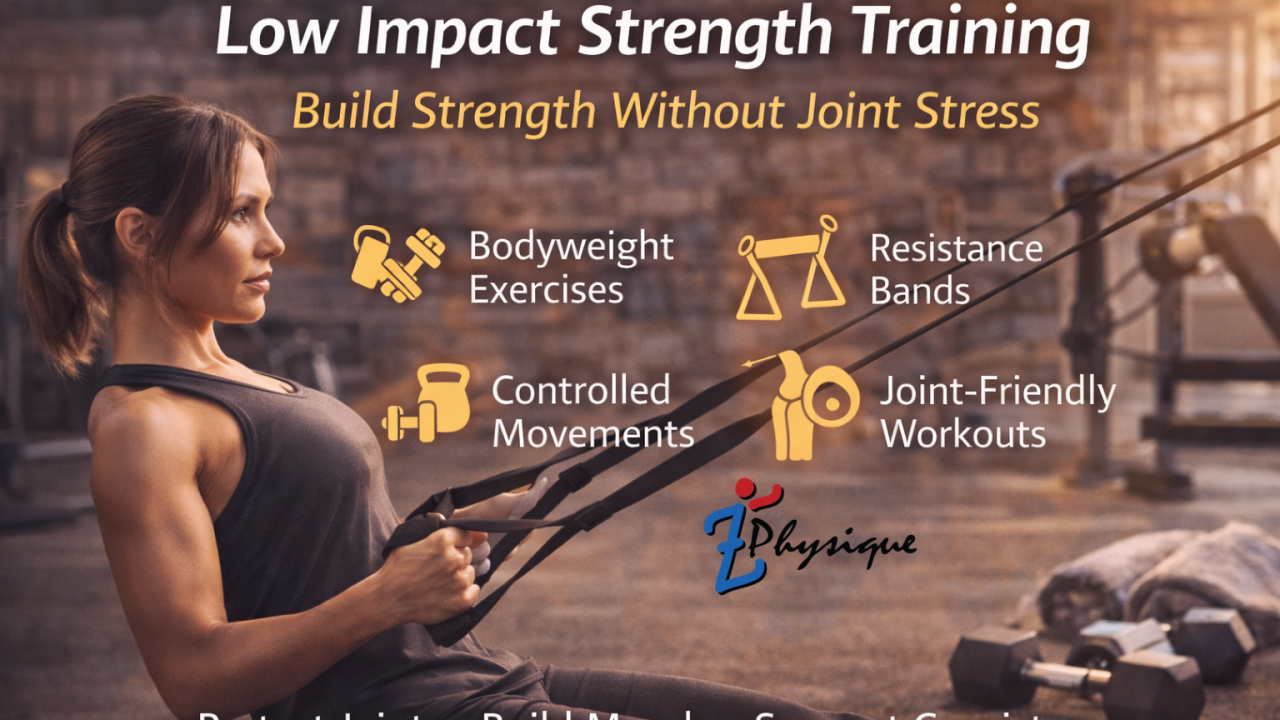
Many people assume strength training must involve heavy weights, explosive movements, or intense workouts. However, low impact strength training offers a powerful alternative that helps build muscle, improve mobility, and increase overall strength while placing less stress on the joints.
This approach is especially helpful for busy adults who want to stay active without risking injury or burnout. When workouts support your body instead of exhausting it, consistency becomes easier to maintain.
What Is Low Impact Strength Training?
Low impact strength training focuses on controlled movements that build muscle while minimizing joint stress.
Instead of explosive exercises or high-impact movements, workouts emphasize stability, balance, and muscular control.
Common low impact strength exercises include:
🏋️ Bodyweight squats
💪 Dumbbell rows
🧱 Plank variations
🤲 Resistance band exercises
🦵 Glute bridges
These movements strengthen muscles while protecting the joints.
Because the exercises are controlled and repeatable, they fit well into sustainable training routines.
How Low Impact Strength Training Improves Movement Quality
One of the most valuable benefits of low impact strength training is improved movement quality.
Many people experience discomfort or stiffness during everyday activities such as bending, lifting, or climbing stairs. Often this occurs because supporting muscles are weak or movement patterns have become inefficient.
Low impact strength exercises focus on slow, controlled movements that reinforce proper mechanics. Instead of rushing through repetitions, the emphasis is on stability and muscular engagement.
For example:
🦵 Controlled squats strengthen the hips and knees
🧱 Planks reinforce core stability and posture
🤲 Rows improve upper-back strength and shoulder alignment
🏋️ Glute bridges activate the posterior chain
As these muscles become stronger, everyday movement often becomes easier and more comfortable.
Over time, these improvements in movement quality can reduce joint strain and help prevent common overuse injuries.
Why Joint-Friendly Strength Training Matters
As we get older, protecting joint health becomes increasingly important.
High-impact workouts can place significant stress on the knees, hips, and lower back. Over time, that stress can lead to discomfort or injury.
Low impact strength training reduces that strain while still delivering meaningful results.
Benefits include:
🦴 Stronger supporting muscles around joints
⚖️ Improved balance and stability
🧘 Better mobility and movement quality
💪 Increased muscular strength
Because the exercises emphasize proper mechanics, they also help reinforce safer movement patterns in everyday life.
Strength Training Supports Long-Term Health
Strength training provides benefits far beyond building muscle.
According to the Mayo Clinic, regular strength training can help improve bone density, increase metabolism, and support overall physical function.
These benefits become even more powerful when training is performed consistently.
Low impact strength training makes that consistency easier because the workouts feel sustainable rather than exhausting.
Low Impact Does Not Mean Low Results
A common misconception is that low impact workouts are less effective.
In reality, strength gains depend more on muscle tension and progressive overload than on explosive movement.
Even controlled exercises can produce significant improvements when you gradually increase:
📈 Resistance
⏱ Time under tension
🔁 Repetitions
🏋️ Training frequency
This means low impact strength training can still build muscle and improve strength while remaining joint-friendly.
Progressive Overload Without High Impact
Strength development occurs when muscles gradually adapt to increasing levels of resistance. This principle, known as progressive overload, does not require explosive or high-impact exercises.
Instead, low impact strength training can create progressive overload through controlled adjustments.
For example:
📈 Increase dumbbell weight gradually
🔁 Add additional repetitions to each set
⏱ Slow the tempo of each repetition
🧘 Increase time under tension for each movement
These adjustments allow muscles to continue adapting while minimizing unnecessary joint stress.
Because the movements remain controlled, this method often leads to steady progress without the fatigue or strain that can accompany high-impact training styles.
Over time, progressive overload applied through low impact strength exercises can build significant strength while remaining sustainable.
Structured Workouts Help Maintain Progress
One challenge many people face with strength training is knowing what exercises to perform.
Without structure, workouts can feel random and inconsistent.
Following a guided program helps remove that uncertainty.
Many members maintain progress by following the structured video workouts available inside the Z Physique training library.
You can explore those workouts here
These follow-along sessions provide clear instruction, proper pacing, and structured progressions designed to support sustainable strength development.
Community Support Improves Consistency
Staying consistent with fitness becomes easier when you feel supported.
Encouragement from others can reinforce healthy habits and provide motivation during busy weeks.
Inside the Z Physique community, members share wins, ask questions, and support one another through their fitness journeys.
You can join the supportive community here
Having a community alongside your workouts often makes a significant difference in long-term adherence.
Nutrition Supports Strength Development
Strength training and nutrition work together to support muscle growth and recovery.
Fortunately, nutrition doesn’t need to be complicated.
Simple habits often make the biggest difference:
🥗 Balanced meals
💧 Staying hydrated
🍎 Whole food choices
🍽 Consistent meal timing
According to the Mayo Clinic’s guidance on nutrition basics, balanced meals containing protein, fiber-rich carbohydrates, and healthy fats help support steady energy and overall wellness.
When nutrition supports training, strength development becomes more sustainable.
Consistency Is the Real Key to Strength
The most effective workout program is the one you can repeat consistently.
Low impact strength training supports this goal by reducing fatigue, protecting joints, and fitting into busy schedules.
Instead of pushing your body to exhaustion, you build strength gradually.
Over time, those consistent sessions compound into meaningful progress.
This approach allows you to stay active, feel stronger, and maintain your fitness routine long term.
How Low Impact Training Supports Long-Term Fitness
Many people stop exercising not because they lack motivation, but because their workouts become too demanding to maintain.
High-intensity routines may produce short bursts of progress, but they often become difficult to sustain for months or years.
Low impact strength training offers a more realistic long-term approach.
Because the workouts place less stress on the body, they are easier to repeat consistently. This consistency is what ultimately leads to measurable results.
Over time, consistent training can help support:
💪 Stronger muscles
⚡ Improved daily energy
🧠 Better mental focus
🦴 Stronger bones and joints
Rather than chasing short-term intensity, this approach focuses on creating a routine that supports health for years to come.
That long-term perspective is what makes low impact strength training such an effective strategy for sustainable fitness.
Take the Next Step
If you want to build strength without unnecessary strain, low impact strength training is a great place to begin.
Start by:
🏋️ Following structured workout programs on the Z Physique website
🥗 Supporting workouts with RD-created meal plans in the Z FIT Studio app
🤝 Connecting with others inside the Z Physique community
When workouts are sustainable, consistency becomes natural.
And when consistency becomes a habit, strength follows.
