Last updated: October 24, 2026
Think about the last time you took a walk without feeling rushed. Maybe you noticed the rhythm of your steps, the way your breathing settled after a few minutes, or how your shoulders gradually relaxed as you moved. You might not have thought of it as anything more than getting outside for a little exercise, but something else was happening. You were paying attention to how your body felt.
We often separate physical fitness from mental well-being, as though improving one requires a different set of activities than improving the other. Exercise becomes something we do for strength, endurance, or weight management, while relaxation and stress management become separate responsibilities competing for space in an already busy schedule.
Yet movement and attention don’t have to exist in separate parts of our lives. Many familiar activities involve some combination of physical coordination, breathing, concentration, and awareness. When we begin noticing those connections, exercise can become an opportunity to understand how we’re moving and responding, rather than simply completing another task. That’s part of what makes mind-body exercise worth exploring.
What Makes an Exercise a Mind-Body Practice?
Mind-body practices generally involve intentionally connecting physical movement, breathing, attention, or relaxation. Some, such as yoga and tai chi, have long traditions built around these elements. Others, including walking and strength training, can incorporate greater awareness without necessarily being classified as traditional mind-body disciplines.
Paying attention during a strength workout isn’t quite the same as practicing yoga or participating in a structured mindfulness program. Each activity offers something different, and understanding those differences helps us appreciate what they can realistically contribute.
Consider the difference between rushing through a set of exercises while thinking about everything you still need to accomplish and taking a moment to notice your posture, breathing, and control. The physical movements might be identical, but your attention is directed toward what you’re doing rather than simply getting through it. That awareness can be useful for learning movement skills, recognizing unnecessary tension, and becoming more comfortable with exercise. It may also provide a welcome opportunity to redirect your attention away from the demands of the day.
The following seven activities offer different ways to explore that connection. You don’t need to practice all of them, and you may discover that one or two fit naturally into what you’re already doing.
1. Yoga: Exploring Movement, Breathing, and Control
Yoga is probably one of the first activities people think of when they hear the term mind-body exercise. Although there are many styles and approaches, physical yoga practices commonly combine postures, breathing, and focused attention.
What makes yoga interesting isn’t simply the flexibility involved. Moving into a posture, maintaining your balance, and noticing how your breathing changes all require a degree of awareness that can be easy to overlook during other activities.
For someone who spends much of the day sitting, a gentle yoga session might provide an opportunity to move through positions that feel unfamiliar or restricted. Someone who exercises regularly may appreciate the chance to practice controlled movement without making intensity the primary objective.
Yoga doesn’t need to involve difficult poses or exceptional flexibility. Chair-based practices, supported positions, and beginner-friendly routines can make participation more approachable, although individual modifications may still be necessary.
Research suggests that yoga may support certain aspects of physical function and psychological well-being. Some studies have also examined its potential role in managing specific symptoms and health conditions. However, results vary according to the type of yoga, the population being studied, and the outcomes researchers measure. Yoga shouldn’t be presented as a guaranteed solution for chronic pain, anxiety, or other health concerns.
A useful place to begin is with a few comfortable movements while paying attention to your breathing and how your body responds. The goal isn’t to force yourself into a position, but to explore movement with patience and control.
2. Tai Chi: Practicing Balance Through Deliberate Movement
Tai chi developed from Chinese martial arts traditions and is now practiced in several forms, including approaches emphasizing health, balance, and coordinated movement.
If you’ve watched someone practicing tai chi, you may have noticed how slowly and deliberately they move. Their weight shifts from one leg to the other, their arms follow coordinated patterns, and each movement transitions into the next. Although the movements may appear effortless, they require attention to posture, balance, and timing, particularly as the body moves between different positions.
One of tai chi’s practical benefits is the opportunity to practice controlling your center of gravity while moving. Instead of standing still and trying to maintain balance, you’re learning to shift your weight and coordinate different parts of your body.
This can be particularly relevant as we get older, when maintaining balance and confidence with everyday movement becomes increasingly important. Research involving older adults has found that tai chi can improve measures of balance and reduce fall risk, although outcomes depend on factors such as the participants, program, and duration of practice.
Tai chi may also provide a calming experience for some participants, although that shouldn’t be confused with a guarantee that it will treat anxiety or depression.
For beginners, a class or appropriately guided routine can help establish safe movement patterns. Even learning a few basic weight shifts can introduce the idea of moving with greater awareness and control.
3. Qigong: Connecting Gentle Movement and Focused Attention
Qigong is another practice with roots in Chinese traditions. It includes a broad range of approaches that may combine gentle movements, breathing, posture, and focused attention.
Although qigong and tai chi share certain characteristics, they aren’t interchangeable. Tai chi commonly uses coordinated sequences of movements, while many qigong practices emphasize simpler patterns that may be repeated individually.
A beginner might practice slowly raising and lowering the arms, shifting weight between the feet, or coordinating a comfortable movement with the natural rhythm of breathing. The movements themselves may be uncomplicated, but they encourage attention to how the body moves.
This can make qigong appealing to people who want to explore gentle activity without learning a lengthy sequence. Some practices can be adapted for seated participation, although accessibility depends on the specific routine.
Research into qigong has explored possible effects on psychological well-being, physical function, and certain symptoms. Some findings are encouraging, but studies vary considerably in their methods and quality. Evidence from studies that combine tai chi and qigong also cannot automatically be attributed to qigong alone, so broad claims about healing, disease prevention, or predictable mental health improvements aren’t justified.
For many people, the practical value may be more straightforward. Qigong offers a structured opportunity to slow down, move comfortably, and pay attention without making physical intensity the focus.
4. Progressive Muscle Relaxation: Learning to Recognize Tension
Not every mind-body practice involves continuous movement. Progressive muscle relaxation is a technique that involves gently tensing and releasing different muscle groups while noticing the difference between those sensations.
You might begin with your hands, briefly making a comfortable fist before allowing your fingers to relax. As you release the tension, you pay attention to how the muscles feel compared with a few moments earlier. The process can continue through other muscle groups, often following a structured sequence.
This practice can be useful because physical tension isn’t always obvious while we’re experiencing it. We may spend hours with our shoulders raised, our jaw tightened, or our hands clenched without giving those habits much thought. Progressive muscle relaxation creates an opportunity to recognize that tension and practice releasing it.
Research suggests that progressive muscle relaxation can help reduce symptoms of stress and anxiety in some adults. However, the studies differ in their populations, methods, and treatment approaches, which makes it difficult to predict exactly how much an individual will benefit.
The technique should remain comfortable. Strong contractions, painful movements, or deliberately tensing an injured area aren’t necessary. Some people may benefit from a modified approach that focuses on noticing and releasing tension without first tightening the muscles. The purpose is to become more familiar with the difference between holding tension and allowing it to ease.
5. Strength Training: Paying Attention to How You Move
Strength training isn’t usually placed in the same category as yoga or tai chi, but it offers a meaningful opportunity to develop physical awareness.
Think about performing a simple dumbbell row. You need to position your body, maintain a stable posture, move the weight through a controlled range, and coordinate your breathing. When you’re learning the exercise, paying attention to those details can help you develop confidence and improve your technique.
That attention becomes especially useful when you’re trying to recognize whether a movement feels controlled or whether you’re compensating in ways you hadn’t noticed.
Strength training also provides an opportunity to understand how your body responds to effort. You begin recognizing the difference between normal muscular exertion, fatigue, and discomfort that may signal a need to adjust the exercise.
The established benefits of resistance training include improvements in muscular strength and physical function. Research has also found that resistance training may help reduce depressive symptoms, although individual responses vary.
Those findings don’t necessarily mean that concentrating more closely on a particular exercise produces additional psychological benefits. Paying attention to movement is better understood here as a practical way to learn technique, develop control, and recognize how your body responds.
You don’t need to turn every repetition into an exercise in intense concentration. Instead, consider choosing one aspect of your movement to notice, such as your posture, the path of the weight, or whether you’re maintaining control throughout the exercise. Over time, that awareness can become part of how you approach strength training rather than an additional task.
6. Mindful Breathing: Creating a Moment of Attention
Breathing happens automatically, which makes it easy to forget how much our breathing patterns can change throughout the day. During physical activity, breathing naturally responds to the body’s need for oxygen and the demands of exercise. During periods of stress, we may also notice changes in breathing rate, depth, or rhythm.
Mindful breathing generally involves intentionally directing attention toward the experience of breathing. Some approaches encourage observing the breath as it naturally occurs, while others introduce deliberate changes in breathing pace or pattern. These approaches are related, but they aren’t identical, and research investigating structured breathwork doesn’t necessarily establish the same effects for simply observing natural breathing.
If you’d like to explore mindful breathing, you might begin by sitting comfortably and noticing the sensation of air moving in and out. Rather than trying to take the deepest breath possible, allow your breathing to remain easy while paying attention to its natural rhythm.
If it feels comfortable, you might experiment with a slightly slower pace or a relaxed exhalation. That’s a different approach from observation alone, and it should remain gentle rather than forced.
Breathing interventions have been studied for their potential effects on stress and psychological well-being. Some findings are encouraging, although results vary by technique, study design, and individual response.
Not everyone finds focused breathing comfortable. If concentrating on your breath causes dizziness, respiratory discomfort, or increased anxiety, stop the exercise and consider another relaxation approach. Persistent or concerning symptoms warrant guidance from an appropriate healthcare professional.
One advantage of mindful breathing is that it doesn’t require equipment or a dedicated workout. It can be explored while sitting quietly, before beginning an activity, or during a brief pause in a busy day.
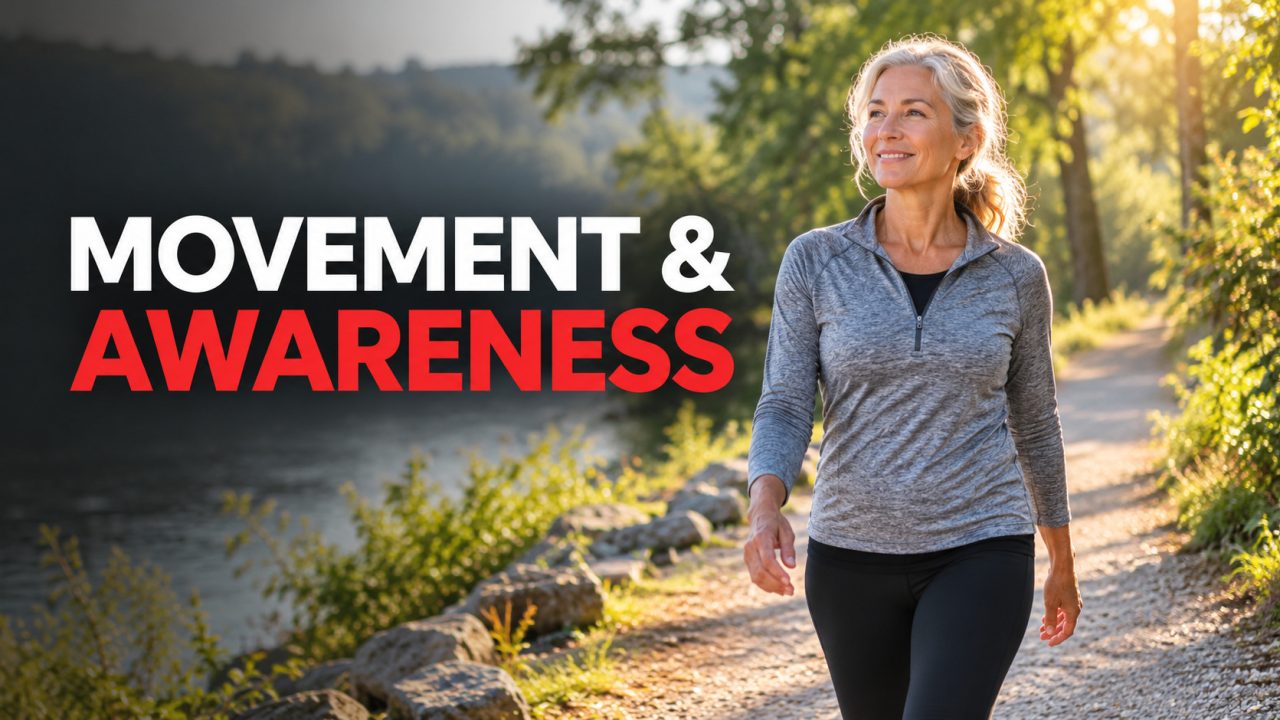
7. Walking: Finding Awareness in a Familiar Activity
Walking may be the most familiar activity on this list, and that familiarity is part of what makes it valuable.
Most of us walk throughout the day without giving much thought to the movement itself. We walk to the car, through the grocery store, around the house, or along a familiar neighborhood route. Sometimes we’re focused on where we’re going. Other times we’re thinking about work, family responsibilities, or something that happened earlier in the day.
There’s nothing wrong with that. Walking doesn’t have to become a formal mindfulness practice to be beneficial, but occasionally directing your attention toward the experience can offer something different.
You might notice the rhythm of your steps, the movement of your arms, or how your breathing changes as you settle into a comfortable pace. If you’re outdoors, you might pay attention to the temperature, sounds, or details of your surroundings that you ordinarily pass without noticing.
Some people enjoy walking with music, while others prefer quiet. Neither approach is inherently better. The useful question is what helps you feel comfortable, attentive, and engaged with the activity.
Walking has well-established physical health benefits. Research also indicates that walking interventions can reduce depressive and anxiety symptoms, although outcomes vary across studies and participants.
Those findings support walking as a worthwhile form of physical activity. They don’t necessarily demonstrate that deliberately paying attention to your steps or surroundings provides additional mental health benefits beyond walking itself.
For someone who already walks regularly, however, occasionally directing attention toward the experience may offer a simple way to explore greater movement awareness without learning an entirely new activity.
How to Bring Mind-Body Awareness Into Everyday Movement
After reading about seven different practices, it would be easy to assume that improving your well-being requires finding time for several new routines. That isn’t the intention.
If you enjoy yoga or tai chi, those activities may become meaningful parts of your week. If you’re curious about qigong or progressive muscle relaxation, you might explore a beginner-friendly introduction. But if you’re already strength training or walking, you have opportunities to practice greater awareness without adding anything to your schedule.
During a strength workout, you might spend a few repetitions paying closer attention to your posture and movement control. On a walk, you might notice your surroundings instead of automatically reaching for your phone. During a busy afternoon, you might take a moment to recognize that your shoulders are tense and allow them to relax.
None of these small choices needs to become another habit you measure or track. It’s also worth remembering that awareness isn’t the same as constant self-monitoring. Exercise should still leave room for enjoyment, conversation, music, and moments when you simply move without analyzing every detail.
The goal is to develop a little more familiarity with how your body feels and responds, then use that understanding when it’s helpful.
Movement Is More Than Something We Complete
It’s natural to measure exercise by what we can see or record. We notice how far we’ve walked, how much weight we’ve lifted, or whether we’ve completed the workout we planned.
Those measures can be useful. They help us recognize progress and maintain consistency, but they don’t capture everything we gain from moving regularly.
Learning to balance during a controlled movement, recognizing when our shoulders are unnecessarily tense, or becoming more comfortable with an unfamiliar exercise may not appear on a fitness tracker. These experiences can still contribute to how confidently we move through everyday life.
Mind-body awareness doesn’t require a particular exercise, a perfect breathing technique, or an entirely new routine. It begins with paying attention when that attention can help us move more comfortably and deliberately.
The next time you go for a walk, pick up a pair of dumbbells, or spend a few minutes stretching, notice one thing about how your body is moving. You don’t need to change anything immediately. Sometimes understanding begins with simply recognizing what’s already happening.
Research Perspective
Research supports several of the physical and psychological benefits discussed in this article, although the strength of the evidence varies among activities.
Studies of tai chi have found improvements in balance and reductions in fall risk among older adults. Research has also identified potential benefits of progressive muscle relaxation for stress and anxiety symptoms, resistance training for depressive symptoms, and walking for psychological well-being.
Breathing interventions and practices such as yoga and qigong have also been studied for their effects on stress, mood, and physical function. However, differences in techniques, participants, and study quality mean that results shouldn’t be generalized to every individual or practice.
Importantly, research demonstrating the benefits of an activity doesn’t automatically establish that adding deliberate awareness produces further benefits. Paying attention to movement can be a practical way to explore technique, comfort, and control, but it shouldn’t be presented as a guaranteed mental health intervention.
Selected Research
- Tai Chi and Fall Prevention (2023): A systematic review and meta-analysis examining balance and fall prevention among older adults.
- Progressive Muscle Relaxation (2024): A systematic review examining stress, anxiety, and depressive symptoms in adults.
- Resistance Training and Depressive Symptoms (2018): A meta-analysis of randomized clinical trials published in JAMA Psychiatry.
- Breathwork and Stress (2023): A meta-analysis examining breathing interventions and stress outcomes.
- Walking and Psychological Well-Being (2024): A systematic review and meta-analysis of randomized controlled trials.
- Exercise and Depressive Symptoms (2024): A systematic review and network meta-analysis published in The BMJ, examining several exercise modalities, including yoga and tai chi/qigong.
Your Next Step
Building a healthier lifestyle doesn’t require changing everything at once. Sometimes it begins with understanding your options and finding a few habits that work for you.
If you’d like practical guidance on getting started, explore our free Healthy Lifestyle Starter Guide. It’s designed to help you approach fitness, nutrition, and everyday wellness with greater clarity and confidence.
About Z Physique
Z Physique was founded by Evan Zingman, an NSCA-Certified Personal Trainer with more than 15 years of experience helping people build healthier, stronger lives.
Our approach focuses on practical fitness education, sustainable nutrition habits, and realistic strategies that fit into everyday life. We believe lasting progress comes from understanding what works, building consistency, and having the support to keep moving forward.
