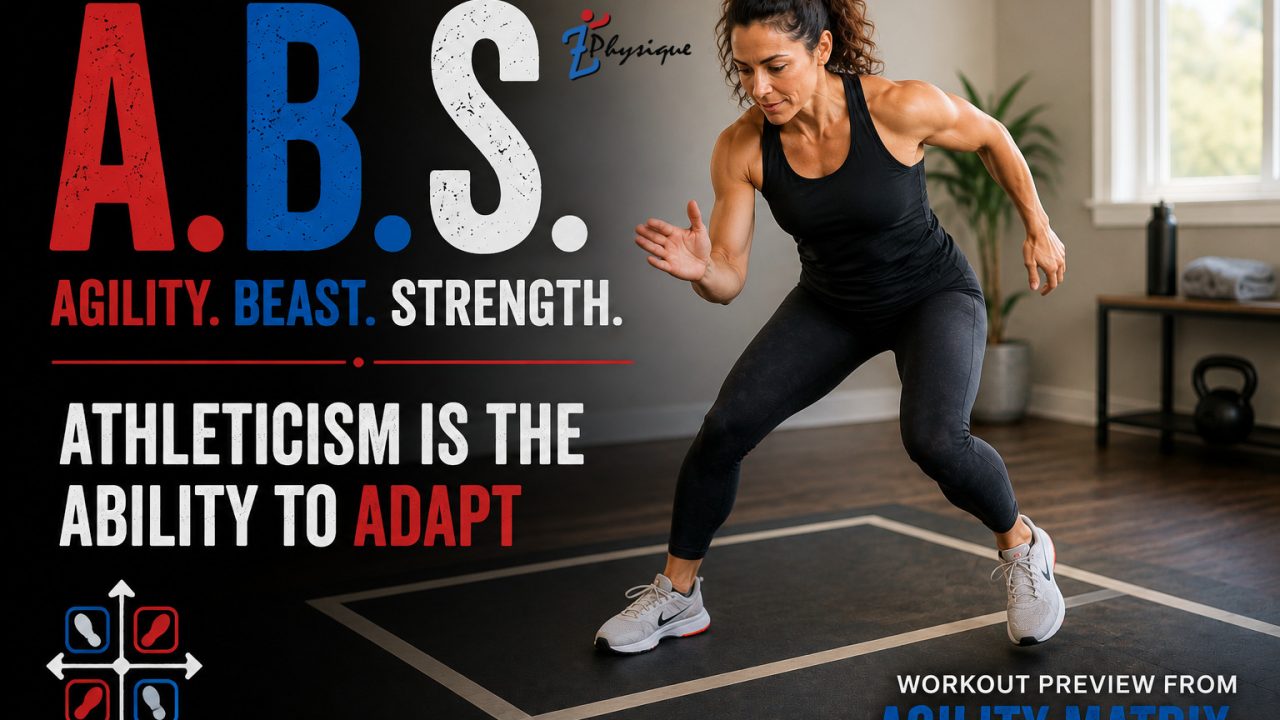
This week’s A.B.S. workout preview from Agility Matrix asks your body to do something familiar workouts don’t always require: adapt when the movement changes.
There are some movements we become comfortable with because we know exactly what’s coming next. We settle into a familiar exercise, find our rhythm, and let our bodies do something they’ve done many times before. There’s value in that familiarity. It’s one of the ways we build strength, confidence, and consistency.
But real life doesn’t always give us that kind of warning. Sometimes we have to change direction, catch ourselves when we step awkwardly, move around something unexpectedly, or get down to the floor and back up again. We may have to react first and figure out exactly what happened afterward.
That’s a different kind of physical ability, and it’s one of the reasons I think athleticism deserves a broader definition than we sometimes give it. You don’t have to compete in a sport to be athletic. You don’t have to run fast, jump high, or train like you did twenty years ago. Sometimes athleticism is simply being able to adapt when the movement changes.
That’s what makes this week’s Workout of the Week, A.B.S., so interesting.
When the Workout Keeps Changing
A.B.S. stands for Agility. Beast. Strength. Rather than spending the entire workout practicing one style of movement, Coach Ro brings three very different types together. You’ll move through lively agility patterns, transition into grounded Beast-inspired movement, and then shift again into full-body strength.
Just when your body begins figuring out one thing, you’re asking it to do something different. Your muscles are working, of course, but so is your attention. You have to listen for the next cue, recognize what Ro is asking you to do, adjust your position, and get your body moving in a new way.
Sometimes it will click immediately. Other times, your brain may know exactly where you’re supposed to go while your feet have apparently made other plans.
I think there’s value in both.
What to Expect in This A.B.S. Workout Preview
This week’s A.B.S. workout preview comes from Agility Matrix, a four-week athletic-style training program created for everyday people.
For the program, you’ll create a simple Matrix on the floor using four pieces of floor-safe tape. Ro uses a square approximately 2½ feet by 2½ feet, but the size isn’t a rule. It should fit your stride, available space, and ability to move safely in, out, across, and around it.
For A.B.S., that Matrix becomes the setting for three distinct movement styles. You’ll move through agility work that challenges your direction and coordination, grounded Beast-inspired patterns that change your relationship with the floor, and strength movements that ask your whole body to contribute.
The objective isn’t to prove how quickly you can master everything. It’s to experience what happens when your body has to keep adapting.
Equipment: Four pieces of floor-safe tape and clear space to move
Style: Agility, coordination, grounded movement, and full-body strength
Athleticism Isn’t Reserved for Athletes
The word athleticism can carry some baggage. It can make us picture competitive sports, younger bodies, complicated drills, or people whose physical abilities seem very different from our own. If that’s our definition, it’s understandable that many adults stop thinking of themselves as athletic somewhere along the way.
But what if we looked at it differently?
Being able to accelerate matters, but so does being able to stop. Moving quickly can be useful, but so is changing direction with control. Strength matters, but so does coordinating that strength when your body isn’t moving in a perfectly straight line. Reaction matters too, because we don’t get to plan every movement we make in everyday life. Balance and coordination training matter too, because we don’t get to plan every movement we make in everyday life.
Seen that way, athleticism becomes much more relevant. It’s not about performing like an athlete. It’s about maintaining enough physical capability to respond to the life you’re actually living.
Your Brain Is Part of the Workout Too
One of the things I like most about this style of training is that you can’t completely check out. A movement pattern may require you to remember where your feet are going, and then Ro changes the cue. A different direction appears. The next exercise puts you closer to the floor. Before long, you’re standing again and doing something completely different.
That can feel awkward when it’s unfamiliar, and that’s part of learning something new. You have to pay attention. You’re giving your brain and body an opportunity to solve a movement problem together, and you don’t have to solve it perfectly on the first attempt.
With repetition, you may begin hesitating less. A pattern that initially required your full concentration may become easier to remember. You might change direction more smoothly or recover more quickly after missing a cue.
The workout hasn’t changed.
You have.
Getting It Wrong Is Still Part of the Workout
This may be the most important part. If your feet go the wrong way, you haven’t failed the drill. If you forget the pattern, the workout isn’t ruined. And if you need to slow something down while Ro is moving faster, you’re still training.
There’s a tendency in fitness to think success means performing every repetition correctly from the beginning. But when we’re learning a new physical skill, some of the most useful moments can happen when things don’t go exactly as planned.
You notice. You adjust. You try again.
Eventually, something that once felt completely unfamiliar starts making sense. That’s progress we don’t always measure.
This Week’s Challenge
As you try the A.B.S. preview, give yourself permission to be a beginner at something. Don’t worry about whether your feet always land in exactly the right place or whether you follow every transition perfectly. Pay attention instead to what happens after you lose the pattern.
Can you reset without getting frustrated? Maybe you need to slow down long enough to figure something out. Maybe your feet head in the wrong direction and you laugh before catching the next cue. Those responses matter because being adaptable doesn’t mean always knowing exactly what to do.
Sometimes it means trusting yourself enough to figure out what comes next.
Continue Exploring Everyday Athleticism
A.B.S. is a short preview from Agility Matrix, our four-week program that brings speed, direction changes, reaction, coordination, balance, control, and strength into a style of training designed for everyday people.
Across the program, Coach Ro guides you through five different workouts that repeat over four weeks. As the movements become more familiar, you have opportunities to play with your pace, move with less hesitation, explore different directions, and notice how your coordination develops.
You don’t need an athletic background. You just need some floor-safe tape, a little room to move, and a willingness to try something different.
Start Building Healthier Habits
A healthier lifestyle isn’t built by getting everything right the first time. It’s built by learning, adjusting, and continuing to show up.
Our Healthy Lifestyle Starter Guide offers practical strategies for building sustainable habits around movement, nutrition, hydration, sleep, and everyday health without asking you to change everything at once.
