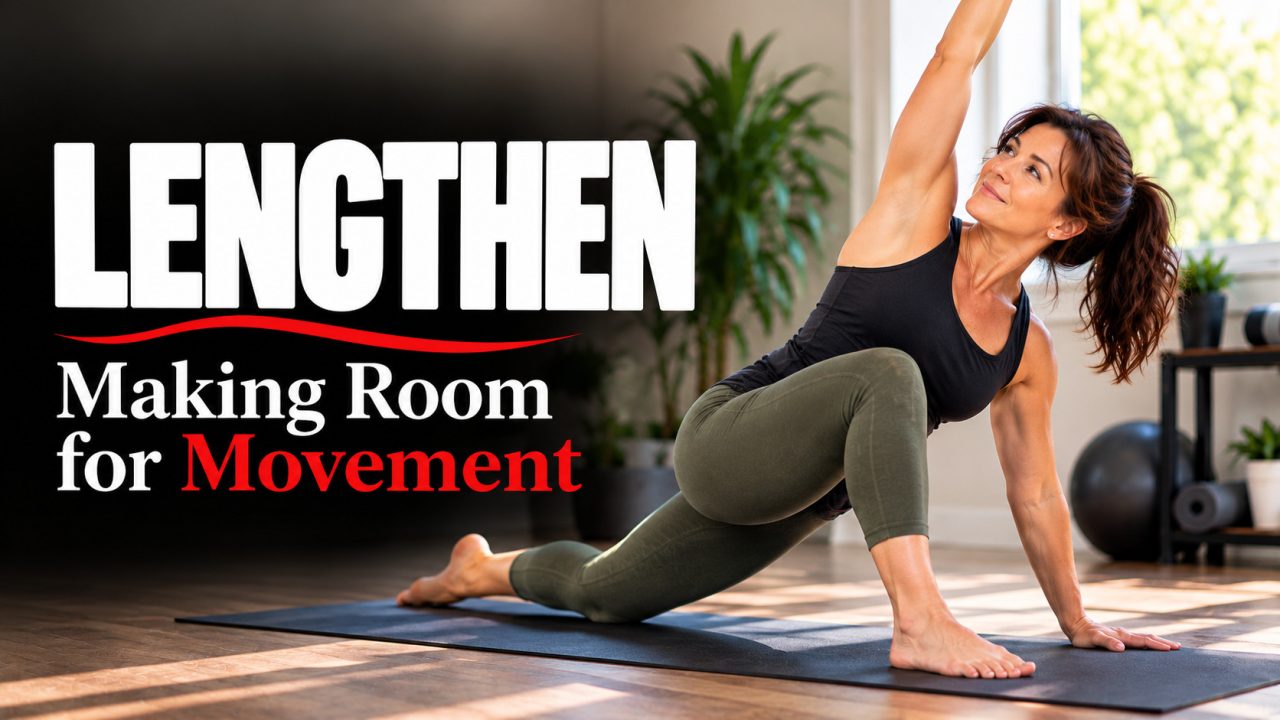
Most of us don’t think much about how freely we move until something begins to feel restricted. It’s something worth considering as we explore this week’s LENGTHEN workout from Coach Ro’s PILATES program.
Maybe you reach into the back seat of your car and notice that turning isn’t as comfortable as it once was. Perhaps getting down onto the floor takes a little more effort than you expected, or you stand up after sitting for a while and need a few moments before your body feels ready to move.
These experiences don’t necessarily mean something is wrong. Our bodies respond to how we spend our days, and movement can feel different depending on our activity, fatigue, and how long we’ve been in one position.
That’s what this week’s preview invites us to explore: something we sometimes overlook when thinking about fitness, the value of making room for movement.
It’s easy to focus on building strength, improving endurance, or completing a challenging workout. Those are worthwhile goals, but there’s another part of physical fitness that deserves attention. We also need to be able to move through the ranges of motion that everyday life asks of us.
And sometimes, improving that experience begins with slowing down enough to notice where we feel comfortable, where we feel restricted, and how our bodies respond when we move with a little more intention.
Mobility Is More Than Stretching
When we think about improving flexibility, we often picture holding a stretch until we feel a muscle begin to loosen. There’s a place for that approach, but mobility involves more than how far we can stretch.
Flexibility generally refers to the range of motion available around a joint, influenced in part by the muscles and other tissues surrounding it. Mobility places greater emphasis on our ability to move through that range with active control and coordination. The distinction between flexibility and mobility is important because having a large range of motion doesn’t automatically mean we can use it comfortably during an activity.
Consider reaching overhead to put something away. Your shoulders need enough mobility to raise your arms, but the movement also involves your upper back, rib cage, and the ability to maintain a comfortable position as you reach.
Or think about stepping into a bathtub, climbing stairs, or turning to look behind you. These familiar activities involve several joints working together, often while we shift our weight or adjust our balance.
Practicing mobility gives us an opportunity to explore those relationships. Rather than concentrating only on how far we can move, we can begin paying attention to how the movement happens.
That awareness is part of what makes mobility training useful.
What to Expect in This LENGTHEN Workout Preview
This week’s LENGTHEN workout preview is approximately seven minutes and thirteen seconds long and comes from Coach Ro’s four-week PILATES program.
LENGTHEN is the fifth workout in the series, with an emphasis on mobility, flexibility, and active recovery. While the earlier sessions introduced core connection, stability, precision, and coordinated movement, this workout provides an opportunity to explore how the body moves through comfortable ranges of motion.
In the preview, Ro demonstrates Pilates-inspired floor movements that include low-lunge positions, controlled rotation through the upper body, and reaching movements that encourage mobility through the hips, spine, and shoulders.
You’ll notice that these aren’t simply positions to reach and hold. There are opportunities to move gradually, adjust your position, and become more familiar with how different parts of the body contribute to the exercise.
The emphasis is on controlled, comfortable movement rather than forcing yourself into a particular shape or trying to achieve the greatest possible stretch.
Preview Length: Approximately 7 minutes, 13 seconds
Equipment: Exercise mat and enough room to move comfortably
Style: Pilates-inspired mobility, flexibility, controlled stretching, and active recovery
More Range Isn’t Always Better
There’s a tendency to measure stretching and mobility by how far we can go.
If we can reach a little farther, bend a little deeper, or move into a position that once felt difficult, we may see that as progress. Sometimes it is. An increase in comfortable range of motion can be a useful improvement.
But distance alone doesn’t tell us everything. Imagine moving into a deep stretch while holding your breath, bracing against discomfort, or struggling to maintain your position. You may have reached farther, but that doesn’t necessarily mean the movement was more beneficial.
Now consider approaching the same exercise with a slightly smaller range. You’re able to breathe comfortably, maintain control, and notice where the movement is coming from.
That experience may offer more useful information about your current abilities.
Mobility work doesn’t need to become a competition with yesterday’s range of motion or someone else’s flexibility.
As you follow Ro through LENGTHEN, allow yourself to explore what feels appropriate for your body. If a position creates discomfort, reduce the range, adjust your support, or choose a different version of the movement.
The goal is to develop a more comfortable relationship with movement, not to force your body to demonstrate how flexible it can be.
Recovery Doesn’t Have to Mean Doing Nothing
When we talk about recovery, it’s easy to think in terms of stopping.
We finish a demanding workout, take a rest day, and give our bodies time to recover before the next session. Rest is important, particularly after challenging exercise, but recovery doesn’t always require complete inactivity.
Gentle movement can sometimes be a useful part of how we manage the time between more demanding workouts.
A comfortable walk, an easy mobility session, or a few minutes of controlled stretching may help us stay active without placing the same demands on our bodies as a strenuous training session.
This approach is often described as active recovery, and the important distinction is that recovery-oriented movement should match the purpose of the session. If every workout becomes an opportunity to push harder, even our lighter days can begin feeling like another performance test.
LENGTHEN offers a different approach.
Instead of asking how much effort we can produce, we can pay attention to how we’re moving, how our bodies feel, and whether a gentler pace allows us to explore positions that deserve a little attention.
That doesn’t mean mobility work replaces adequate rest or guarantees faster recovery. It simply gives us another way to include movement in a balanced routine.
And for many people, learning to appreciate that kind of session is an important part of developing a sustainable relationship with exercise.
The Positions We Spend Time In Matter
Think about how much of a typical day is spent in relatively familiar positions.
We sit while working, driving, eating, or relaxing. We stand at the kitchen counter, walk through the house, and repeat many of the same movements as we go about our routines.
There’s nothing inherently wrong with sitting or spending time in a comfortable position. The challenge is that our days don’t always provide much variety.
We may spend hours without reaching overhead, rotating through the upper back, moving the hips through a larger range, or getting down onto the floor.
Then, when an activity asks us to move differently, the position can feel unfamiliar.
That doesn’t automatically mean our flexibility has declined or that we need an intensive stretching program. Sometimes it simply reminds us that we haven’t practiced that movement very often.
Mobility exercises give us opportunities to introduce some of that variety.
A controlled rotation can help us explore how our upper body turns. A supported lunge position allows us to experience a different relationship between the hips and legs. Reaching overhead can draw attention to how the shoulders and upper back contribute to movement.
These aren’t dramatic exercises, but they can help us become more familiar with positions that may otherwise receive little attention.
Over time, that familiarity can become a useful part of maintaining our movement capabilities.
Learning to Recognize the Difference Between Effort and Discomfort
One of the more valuable skills we can develop during mobility work is learning to pay attention to what we’re feeling.
Exercise often involves effort. A muscle may feel challenged, a position may require concentration, or a stretch may create a mild sensation of tension.
Those experiences aren’t necessarily reasons to stop.
But there’s an important difference between a manageable stretching sensation and pain that feels sharp, pinching, or otherwise concerning.
We don’t need to push through pain to make a mobility exercise worthwhile.
Sometimes a small adjustment changes the experience. Bending the knee, shifting the hands, reducing the depth of a position, or using additional support may allow us to continue more comfortably.
At other times, the appropriate decision is to stop that movement altogether.
This kind of awareness is especially important because mobility varies considerably between individuals. Our joint structures, training histories, previous injuries, and everyday activities all influence how different positions feel.
There’s no single range of motion that everyone needs to achieve during LENGTHEN.
What matters is exploring movement within your abilities and recognizing when an adjustment is appropriate.
Strength and Mobility Belong Together
Throughout this month’s PILATES series, we’ve explored several ideas that might initially seem separate.
POWERHOUSE introduced the importance of connecting through the center of the body. CONTROL challenged us to maintain that connection while other parts of the body moved. PRECISION encouraged greater attention to positioning and alignment, while FLOW explored how those individual movements begin working together.
LENGTHEN adds another dimension by asking us to consider the ranges of motion available for those movements.
Strength helps us produce and manage force. Stability contributes to maintaining control. Coordination allows different parts of the body to work together, while mobility helps determine the positions and ranges through which those movements can occur.
In everyday life, these abilities rarely operate independently.
Consider reaching down to pick up an object. You need enough movement through the hips, knees, and other joints to approach it comfortably. Your muscles contribute the strength needed to support the movement, while balance and coordination help you adjust your position.
A similar relationship exists when stepping over an obstacle, getting up from the floor, or reaching for something above shoulder height.
That’s why I don’t view mobility as something separate from strength training or an optional activity reserved for days when we have extra time.
It’s one part of developing a body that can respond to the different demands of everyday life.
Making Space for Movement in Everyday Life
One of the challenges with healthier habits is that we often imagine they require a dedicated block of time.
We think about completing a workout, preparing a meal, or following a particular routine. If the day becomes busy and we can’t do everything we planned, it’s tempting to postpone the activity altogether.
Mobility doesn’t always need to work that way.
A few comfortable movements after sitting for a while, some gentle shoulder motion during a break, or a short mobility session at the end of the day can provide opportunities to move in ways our usual routines may not include.
These moments don’t have to become formal workouts or replace more structured exercise. They’re simply ways to introduce movement variety into ordinary life.
Perhaps you notice that turning to look over your shoulder feels restricted after a long drive. Instead of immediately trying to force a larger range, you might explore a few gentle movements when you’re safely out of the car.
Or maybe getting down onto the floor feels unfamiliar. Spending a little time practicing comfortable, supported transitions may help you become more confident with the process.
The value isn’t necessarily in performing a particular stretch perfectly.
It’s in recognizing that movement is something we can continue exploring throughout the day, rather than something that happens only during a scheduled workout.
This Week’s Challenge
As you follow the LENGTHEN preview, choose one movement and pay attention to how your body responds.
Notice where you feel the movement, whether you can breathe comfortably, and how the position changes when you make a small adjustment.
If you’re working through a lunge, for example, you might experiment with a shorter stance or additional hand support. During a rotation, see whether moving through a smaller range allows you to maintain a more comfortable position.
There’s no need to reach farther with every repetition.
Instead, try to recognize the range that allows you to move with control and without forcing the position.
Then consider where that movement might connect to your everyday life.
Does it remind you of turning to reach something, stepping into a different position, or moving from the floor to standing?
The challenge isn’t to become dramatically more flexible in one session. It’s to develop a little more awareness of how your body moves and what helps that movement feel comfortable.
Bringing the PILATES Series Together
With LENGTHEN, we’ve now explored all five workouts in Coach Ro’s four-week PILATES program.
Each session introduces a different aspect of movement, but the ideas are designed to complement one another.
POWERHOUSE helps establish connection through the center. CONTROL develops the ability to maintain that connection while moving. PRECISION brings attention to the details that influence how movement feels. FLOW explores how those elements work together, and LENGTHEN provides an opportunity to focus on mobility, flexibility, and recovery.
Together, they offer a broader way to think about fitness.
The purpose isn’t simply to complete five different workouts. It’s to develop greater familiarity with your body, explore different movement challenges, and recognize how strength, stability, coordination, and mobility contribute to everyday activities.
The full PILATES program includes five guided workouts, approximately 21–26 minutes each, repeated throughout four weeks. Modifications and options allow you to approach the movements at a level appropriate for your experience.
If these weekly previews have helped you think about movement differently, the complete program offers an opportunity to continue practicing the ideas we’ve explored.
Explore the Complete PILATES Program
Start Building Healthier Habits
Sometimes the most meaningful changes to our health begin with paying attention to things we’ve grown accustomed to.
We may notice how long we’ve been sitting, recognize that certain movements feel unfamiliar, or realize that our daily routines leave little time for activities that help us feel our best.
Those observations don’t mean we need to overhaul everything.
They give us a starting point.
Building a healthier lifestyle often involves learning which small adjustments fit our circumstances and finding ways to practice them consistently. Movement, nutrition, hydration, sleep, and recovery all contribute to that process.
Our Healthy Lifestyle Starter Guide offers practical ideas for beginning to build healthier routines without expecting perfection or dramatic changes overnight.
