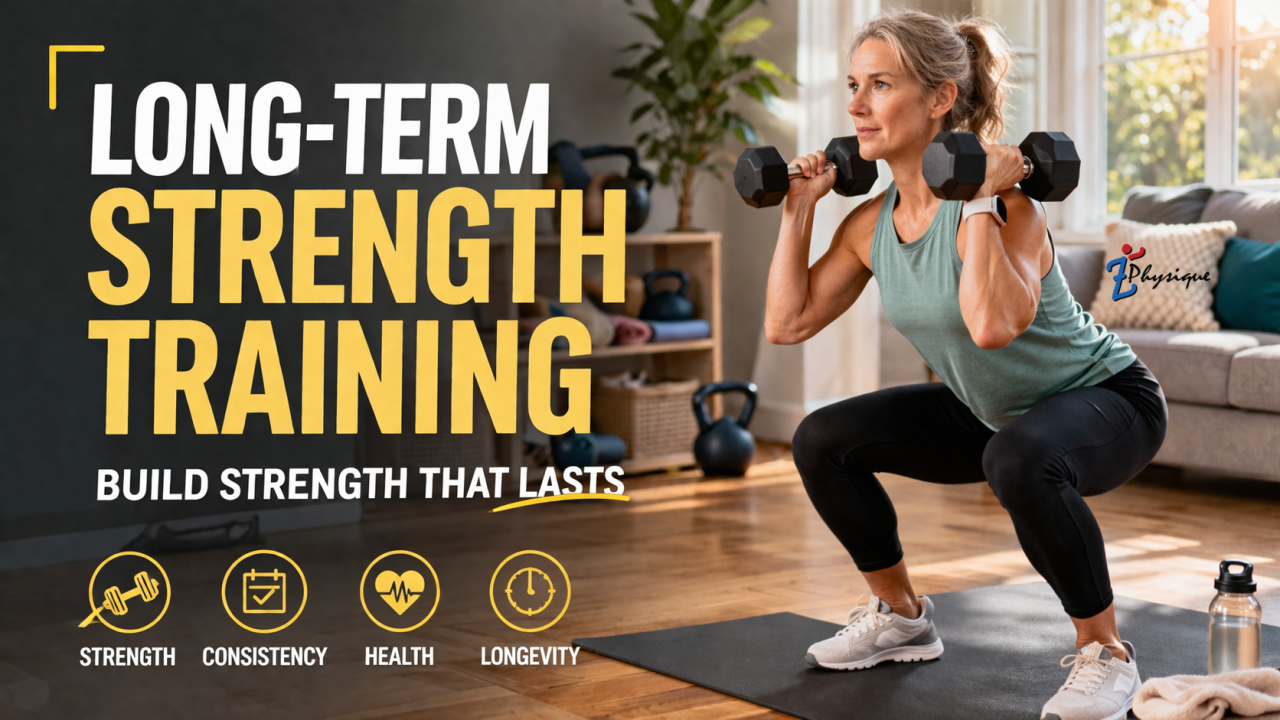
When most people think about fitness, they focus on short-term goals. However, long-term strength training is what truly determines how you feel, move, and live over time.
Losing weight.
Building muscle.
Looking better.
Instead of chasing quick results, the real goal should be much bigger.
👉 How do you stay strong, active, and independent for years to come?
That’s exactly where this approach comes in.
💡 Why Long-Term Strength Training Matters
As you get older, your body naturally changes. However, that doesn’t mean you have to lose strength or mobility.
Muscle mass tends to decrease.
Metabolism may slow down.
Mobility can become limited.
Because of this, strength training becomes essential.
It helps you:
✔ Maintain muscle mass
✔ Improve bone density
✔ Support joint health
✔ Stay mobile and independent
As a result, your workouts begin to support your long-term health—not just short-term goals.
🧠 Long-Term Strength Training vs Short-Term Fitness
Short-term goals can be motivating. However, they often lead to extremes.
Crash diets.
Overtraining.
Inconsistent routines.
On the other hand, long-term strength training focuses on sustainability. Instead of pushing to burnout, you build habits that last.
✔ You progress steadily
✔ You stay consistent
✔ You support your body
Because of this, your results become more reliable and long-lasting.
🔑 The Foundations of Long-Term Strength Training
You don’t need complicated routines. Instead, you need consistency and structure.
Focus on:
🏋️ Full-body workouts
🔁 Functional movement patterns
🧱 Core stability
🧘 Mobility and recovery
When these elements work together, your routine becomes balanced and effective.
🧬 How Long-Term Strength Training Supports Aging
As your body ages, maintaining strength becomes even more important. However, this doesn’t mean training harder—it means training smarter.
Over time, your body experiences:
- Reduced muscle mass
- Decreased bone density
- Slower recovery
Because of this, consistent training becomes critical.
It helps:
✔ Preserve lean muscle
✔ Maintain bone health
✔ Support joint stability
✔ Improve balance and coordination
As a result, everyday movements stay easier and safer.
More importantly, you maintain independence and confidence in your body.
🏠 How to Build Strength at Home
You don’t need a gym to train effectively. In fact, home workouts often improve consistency.
Why?
Because they remove common barriers.
No commute.
No waiting.
No complicated setup.
Instead:
🏋️ 20–30 minute sessions
🏡 Minimal equipment
📅 3–4 days per week
Because of this, your routine becomes easier to maintain.
In addition, many online fitness memberships and best online workout programs are designed this way—simple, effective, and sustainable.
🔁 Consistency Is the Real Key
You don’t need perfect workouts.
Consistency is what drives results.
However, many people fall into the same cycle:
They start strong…
Motivation pushes them early…
Then burnout takes over…
Instead, focus on:
✔ Showing up regularly
✔ Keeping workouts manageable
✔ Building momentum over time
Because consistency—not intensity—is what drives long-term success.
📈 How to Progress Safely Over Time
Progress matters. However, it needs to be controlled.
Instead of rushing results:
🔹 Increase weight gradually
🔹 Improve movement quality
🔹 Add reps slowly
🔹 Adjust intensity as needed
As a result, your body adapts without unnecessary stress.
Over time, this creates steady, reliable progress.
⚖️ Balancing Intensity and Sustainability
It’s easy to think that harder workouts lead to better results. However, pushing too hard often leads to setbacks.
Instead, long-term strength training focuses on balance.
That means:
✔ Training with purpose
✔ Leaving room for recovery
✔ Adjusting based on energy levels
For example:
- Some days you push harder
- Other days you scale back
- But you keep showing up
Because of this, your routine becomes sustainable.
And sustainability is what leads to long-term success.
🧩 The Role of Recovery
Recovery is just as important as training.
Without it:
❌ Fatigue increases
❌ Performance drops
❌ Injury risk rises
Instead, prioritize:
🛌 Sleep
🧘 Mobility work
🚶 Active recovery
💧 Hydration
Because of this, your body can continue improving over time.
🔄 Habit Stacking for Long-Term Success
Consistency doesn’t happen by accident. Instead, it’s built through habits.
One of the most effective strategies is habit stacking.
This means attaching a new habit to something you already do.
For example:
✔ Workout after your morning coffee
✔ Stretch while watching TV
✔ Walk after dinner
Because of this, your routine becomes automatic.
In addition, you remove the need for motivation.
Over time, these small habits build momentum—and that momentum keeps you consistent.
🧠 Strength Training and Mental Well-Being
Physical strength is only part of the equation. However, mental strength matters just as much.
Long-term strength training helps:
✔ Reduce stress
✔ Improve mood
✔ Build confidence
✔ Create structure
Because of this, it becomes more than just exercise—it becomes part of your lifestyle.
🔗 🌟 Science Says…
Strength training plays a critical role in long-term health. According to the Mayo Clinic, regular strength training helps improve muscle strength, bone density, and overall health.
More importantly, consistent training supports mobility and independence as you age.
🏆 Build Strength That Lasts
Your goal shouldn’t just be to get in shape. Instead, it should be to stay strong over time.
That means:
✔ Building sustainable habits
✔ Following a structured plan
✔ Staying consistent
✔ Supporting recovery
Because when you focus on the long term, your results don’t fade—they grow stronger.
🚀 Take the Next Step
If you’re ready to commit to long-term strength:
👉 Follow expertly designed, video-driven workout programs
👉 Get nutrition guidance inside the Z FIT Studio app:
👉 Join our supportive online fitness community
You don’t need extreme workouts.
You need consistency—and a plan that works.
💬 Final Thought
Strength isn’t just about today.
It’s about the future.
It’s about how you move.
And it’s about how you feel.
Because when you commit to long-term strength training, you’re not just working out—you’re building a stronger life.
