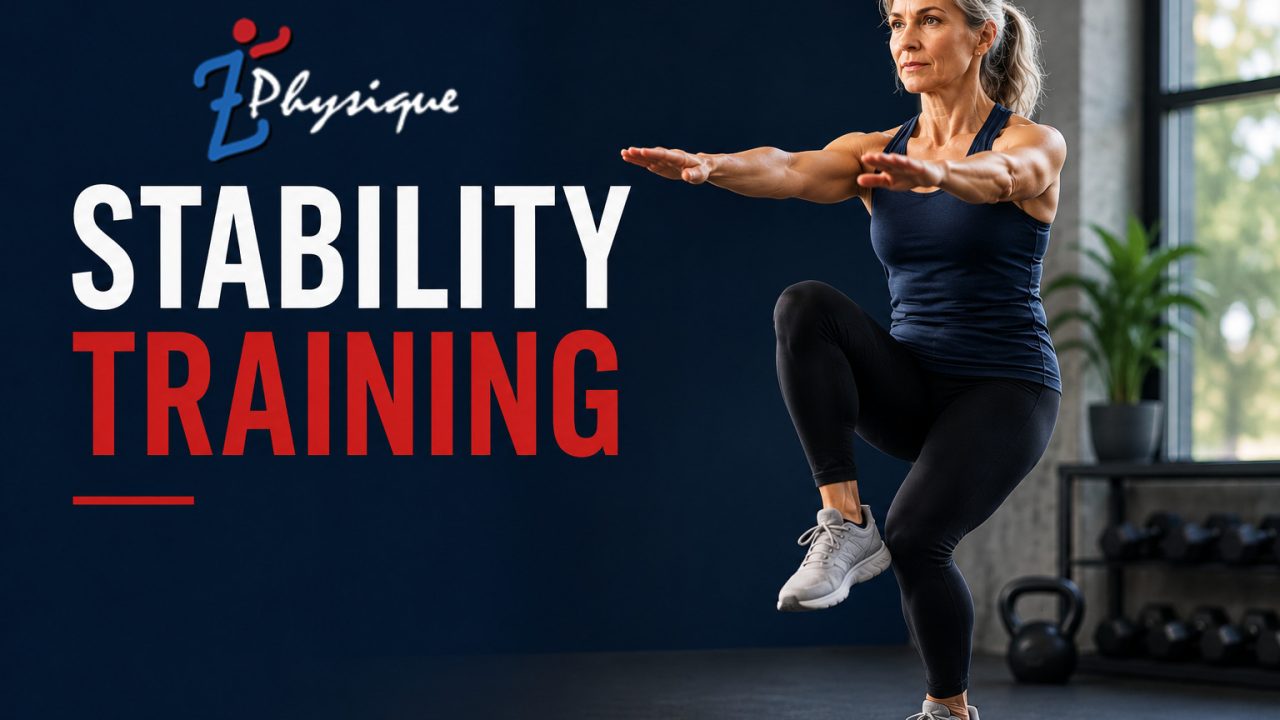
When people think about fitness, they often focus on strength, weight loss, endurance, or flexibility. Stability training rarely receives the same attention.
In fact, many people do not think about stability training at all until something feels off. A loss of balance, recurring aches and pains, difficulty moving comfortably, or a growing sense that everyday activities require more effort than they once did.
Yet stability plays a role in nearly everything we do. It influences how we walk, climb stairs, carry groceries, reach overhead, exercise, and recover from unexpected movements throughout the day. While strength often gets the spotlight, stability frequently provides the foundation that allows strength to be used effectively.
That is one reason stability training becomes increasingly valuable as we get older.
What Is Stability Training?
Stability training focuses on improving the body’s ability to control movement.
While strength allows us to produce force, stability helps us manage that force effectively. Every step, reach, turn, and change in direction requires the body to coordinate muscles, joints, and the nervous system to maintain balance and control.
Most people rarely think about these systems when they are functioning well. However, they are constantly working behind the scenes. Whether you’re carrying groceries across a parking lot, stepping off a curb, climbing stairs, or reaching for something on a high shelf, your body relies on stability to perform those movements smoothly and efficiently.
That is why stability training is about much more than balance exercises. It helps develop the movement control that supports confidence and function throughout everyday life.
Why Stability Becomes More Important Over Time
Many adults notice changes in balance, coordination, and movement quality as they get older.
These changes do not happen because the body suddenly stops working. More often, they reflect how modern life has changed. Many people spend long hours sitting, move through repetitive daily routines, and encounter fewer situations that naturally challenge balance and coordination.
As a result, the body receives fewer opportunities to practice the types of movements that help maintain balance, coordination, and stability. Over time, those skills can become less automatic simply because they are used less frequently.
Fortunately, stability is not a fixed trait. Like strength, it responds remarkably well to consistent practice. The body adapts when given opportunities to challenge balance, coordination, and movement control in a safe and progressive way.
That is encouraging because it means many of the physical abilities people assume are simply disappearing can often be improved through intentional movement.
Stability Supports Everyday Confidence
One of the most overlooked benefits of stability training is the confidence it can create.
People often feel more comfortable moving when they trust their body’s ability to respond appropriately to different situations. That trust develops gradually through experience.
Perhaps you feel steadier walking across uneven ground. Maybe you move through stairs with less hesitation. Perhaps carrying groceries, lifting household items, or participating in recreational activities simply feels easier than it once did.
These moments may not seem particularly significant on their own. However, together they shape how people view their physical capabilities.
Confidence rarely comes from reading about fitness. More often, it develops through repeated experiences that demonstrate what the body can do.
Stability and Strength Work Together
Strength and stability are often discussed as separate qualities, yet they work together constantly.
Strength allows us to produce force, while stability helps us control and direct that force efficiently. One becomes far more useful when supported by the other.
Consider lifting a heavy object from the floor. Strength helps move the load. Stability helps the body maintain balance, posture, and control throughout the movement.
Without adequate stability, strength becomes less effective. The body may compensate with inefficient movement patterns that place additional stress on muscles and joints. Likewise, stability without strength can limit overall capability.
The most resilient bodies develop both qualities together. That is one reason well-designed fitness programs rarely focus on a single component of fitness in isolation.
Stability Training Supports Healthy Aging
Healthy aging is not simply about adding years to life. It is also about maintaining the ability to participate fully in the activities that make life meaningful.
This is where stability training becomes particularly valuable.
The ability to move confidently, maintain balance, react to unexpected changes in position, and navigate daily activities independently influences quality of life far more than many people realize. These skills affect everything from recreational activities and travel to household tasks and social engagement.
While stability training may not receive the same attention as weight loss or strength gains, its impact can be substantial. The confidence that comes from moving well often encourages people to stay active, and continued activity helps support long-term health and independence.
For that reason, stability training is not just about improving workouts. It is about supporting the ability to keep doing the things you enjoy throughout life.
Why Stability Training Matters More Than You Think
Many of the most important aspects of fitness work quietly in the background.
When movement feels smooth, balanced, and controlled, most people never think about the systems making that possible. They simply enjoy the freedom that comes from moving confidently through everyday life.
Stability is one of those often-overlooked qualities that quietly supports nearly every movement we make.
Although it rarely receives the attention given to strength, weight loss, or endurance, it influences nearly every physical activity we perform. From walking and climbing stairs to exercising and participating in recreational activities, stability helps create the foundation that supports efficient movement.
That is why stability training deserves a place in a well-rounded fitness routine.
Not because it is trendy or extreme. Because it helps build the confidence, capability, and movement quality that make everyday life easier, more enjoyable, and more sustainable over the long term.
Why Prime Shift Emphasizes Stability Training
Prime Shift was built around the idea that movement quality matters.
The program incorporates unilateral strength work, balance challenges, coordination drills, and controlled movement patterns that help the body function as an integrated system. Rather than focusing exclusively on muscles, the program emphasizes how movement translates into everyday life.
Many members discover that improvements in stability influence far more than their workouts. Better balance, improved body awareness, greater confidence, and smoother movement patterns often carry into daily activities as well.
That is one reason stability training remains such an important part of the Prime Shift approach.
If you’re looking for structured programs designed to support strength, stability, and long-term progress, explore our workout library.
📚 Backed by Research
Stability training helps support balance, coordination, and movement control, all of which contribute to long-term physical function. According to the Centers for Disease Control and Prevention (CDC), regular physical activity helps improve balance, strengthen muscles, and support independence as adults age.
These benefits align closely with the goals of stability training. By improving the body’s ability to control movement and respond to everyday physical demands, stability-focused exercise can help people move with greater confidence and maintain an active lifestyle over time.
CDC – Benefits of Physical Activity
🤝 Let’s Keep Moving Forward
If you’re ready to build strength, stability, and movement confidence, Z Physique is here to help.
💪 Follow-along video workouts created by certified trainers
⚡ Structured programs designed for real life
🧠 Functional strength, balance, and stability training
🥗 Registered dietitian-created nutrition plans inside the Z FIT Studio app
🔥 Coaching and support focused on sustainable success
Explore the full program library
🎁 New to Z Physique?
Start with our free Healthy Lifestyle Starter Guide:
