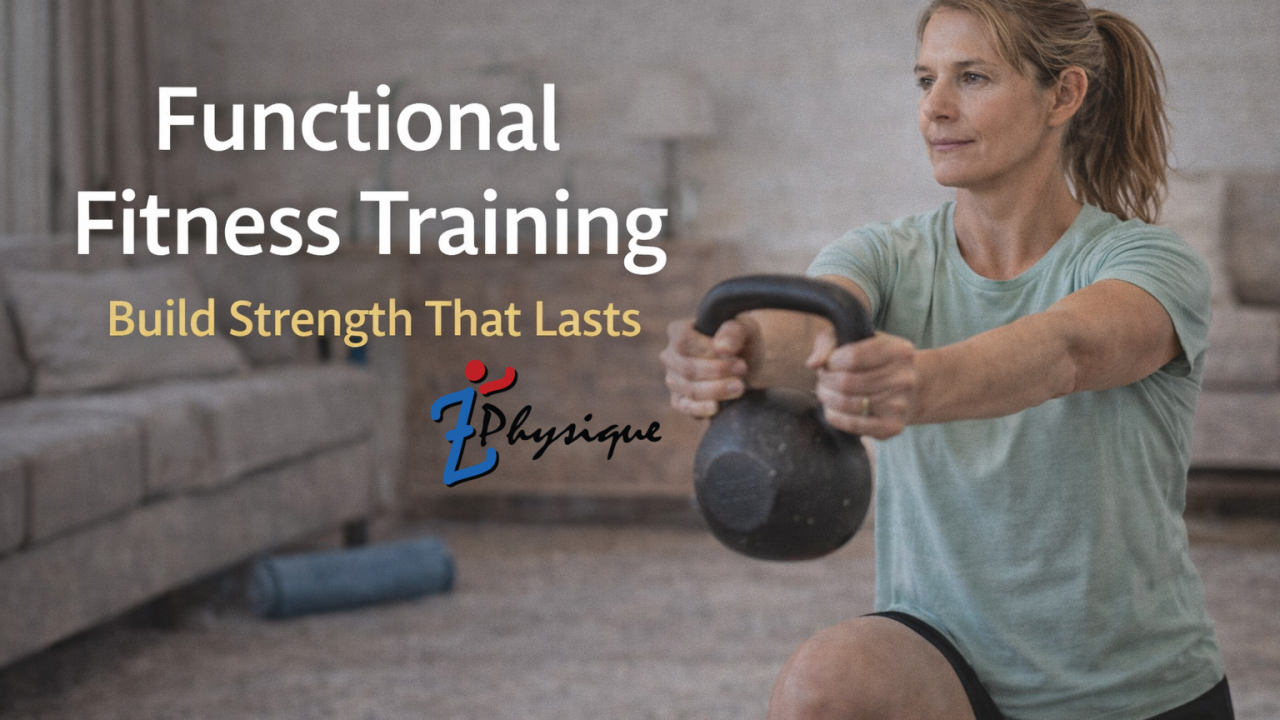
If your goal is to build strength that actually carries over into real life, then functional fitness training is where you need to focus.
Because strength isn’t just about lifting heavier weights. Instead, it’s about how your body moves, performs, and supports your daily life.
That’s exactly what this approach is designed to do.
💡 What Is Functional Fitness Training?
Functional fitness training focuses on movements that mimic real-life actions. Rather than isolating muscles, it trains your body to work as a unit.
For example:
🏋️ Squatting down to pick something up
🛒 Carrying groceries
🧍 Getting up from a chair
🔄 Twisting, reaching, and stabilizing
Because of this, your workouts become more practical and effective.
Over time, your body becomes stronger, more efficient, and more resilient.
🔑 Why This Type of Training Matters
Many traditional workouts focus on individual muscles. While that has value, it doesn’t always translate to real-life strength.
On the other hand, this style of training improves how your body works as a whole. As a result, your strength becomes more usable in everyday situations.
✔ You move more efficiently
✔ You reduce injury risk
✔ You improve balance and coordination
✔ You build strength that actually feels useful
Because of this, your workouts begin to support your life—not compete with it.
🧠 Functional Fitness vs Traditional Strength Training
Both approaches can build strength. However, they do so in different ways.
Traditional Strength Training:
- Focuses on isolated muscle groups
- Often uses machines
- Builds muscle size and strength
Functional Fitness Training:
- Focuses on movement patterns
- Uses multiple muscle groups together
- Improves coordination, balance, and stability
That said, the goal isn’t to choose one over the other. Instead, it’s about understanding how functional fitness training fills a gap many people are missing.
🏠 How to Build Strength at Home
You don’t need a gym to build real strength. In fact, training at home can be even more effective.
Why?
Because your environment naturally encourages real-life movement.
For example:
🏋️ Bodyweight exercises
🏋️ Dumbbells or kettlebells
🏡 Open space for movement
⏱ Short, structured workouts
Because of this, your routine becomes easier to follow.
In addition, many online fitness memberships and online fitness classes are built around this exact approach—simple, efficient, and sustainable.
🔁 Key Movement Patterns to Focus On
To get the most out of your workouts, focus on foundational movement patterns.
🏋️ Squat
Builds lower body strength and improves mobility.
Examples:
- Bodyweight squats
- Goblet squats
🔁 Hinge
Targets the posterior chain.
Examples:
- Deadlifts
- Hip hinges
🚶 Lunge
Improves balance and stability.
Examples:
- Reverse lunges
- Walking lunges
💪 Push
Strengthens the upper body.
Examples:
- Push-ups
- Overhead press
🔗 Pull
Supports posture and back strength.
Examples:
- Rows
- Resistance band pulls
🧱 Core Stability
Connects everything together.
Examples:
- Planks
- Anti-rotation movements
When you train these consistently, your strength becomes more balanced. More importantly, it becomes functional.
📈 How to Progress Without Overcomplicating It
Progress doesn’t require constant change. Instead, it comes from improving within the same movements.
For example:
🔹 Increase weight gradually
🔹 Improve control and stability
🔹 Add reps or time under tension
🔹 Reduce rest time
As a result, these small adjustments create progressive overload.
Over time, they lead to real, noticeable improvements in strength and confidence.
🧠 Mind-Muscle Connection: Train Smarter, Not Just Harder
When people think about getting stronger, they often focus on doing more—more weight, more reps, more intensity.
However, there’s another factor that plays a major role in results:
👉 How well you connect to the movement.
This is known as the mind-muscle connection.
🔍 What Is the Mind-Muscle Connection?
The mind-muscle connection is your ability to consciously engage the muscles you’re trying to work.
Instead of just going through the motions, you:
✔ Focus on the muscle being used
✔ Control each part of the movement
✔ Stay present throughout the exercise
As a result, each rep becomes more effective.
⚡ Why It Matters for Functional Fitness
Functional fitness training isn’t just about movement—it’s about controlled movement.
Because of this, improving your mind-muscle connection helps you:
✔ Activate the right muscles
✔ Improve coordination and balance
✔ Reduce compensation patterns
✔ Lower injury risk
In other words, you’re not just moving—you’re moving with purpose.
🏋️ How to Improve Your Mind-Muscle Connection
You don’t need to overthink this. Instead, focus on a few simple adjustments:
🔹 Slow down your reps
🔹 Focus on form over speed
🔹 Pause briefly at key points
🔹 Think about the muscle you’re working
🔹 Eliminate momentum where possible
For example, during a squat:
- Feel your glutes and legs working
- Stay controlled as you lower down
- Drive through your heels as you stand
Because of this, your workouts become more intentional—and more effective.
🔁 Small Changes, Big Impact
It’s easy to assume that results only come from doing more.
However, doing movements better often creates faster progress.
When you combine:
- Proper movement patterns
- Progressive overload
- Strong mind-muscle connection
You create a system that works.
Not just in the short term—but over time.
🔄 Why This Approach Supports Consistency
Consistency is the foundation of any successful fitness routine. However, consistency becomes much easier when your workouts feel manageable.
This approach works because:
✔ Movements feel natural
✔ Workouts are efficient
✔ Progress is easy to track
✔ Routines are repeatable
Because of this, you’re far more likely to stay consistent.
And when you stay consistent, results follow.
⚡ Simple Weekly Workout Structure
You don’t need complicated programming to get started.
Instead, follow a simple structure:
⏱ 20–30 minutes
🔁 3–4 rounds
🏋️ 5–6 exercises
📅 3 days per week
For example:
- Squat
- Hinge
- Push
- Pull
- Core
This keeps your routine balanced and easy to maintain.
🧩 The Missing Piece: Control and Stability
Many people focus only on moving weight. However, how you move matters just as much.
This type of training emphasizes:
✔ Controlled movement
✔ Proper alignment
✔ Stability through each exercise
As a result, you don’t just get stronger—you move better.
And because of that, your risk of injury decreases while your performance improves.
🔗 🌟 Science Says…
Functional movement and consistent activity play an important role in overall health and longevity. According to the Mayo Clinic, regular exercise helps improve strength, balance, and overall health.
More importantly, consistent movement patterns help maintain mobility and independence as you age.
🏆 Build Strength That Fits Your Life
Your workouts shouldn’t feel separate from your life. Instead, they should support it.
That’s exactly what this approach does.
✔ It prepares you for real-world movement
✔ It builds strength you can feel
✔ It supports long-term health
✔ It fits into your daily routine
Because when your training matches your lifestyle, it becomes sustainable.
And when it becomes sustainable, it becomes successful.
🚀 Take the Next Step
If you’re ready to build strength that carries into real life:
👉 Follow expertly designed, video-driven workout programs
👉 Get nutrition guidance inside the Z FIT Studio app:
👉 Join our supportive online fitness community
You don’t need complicated workouts.
You need ones that work—and ones you’ll stick with.
💬 Final Thought
Strength isn’t just about what you can lift.
It’s about how you move.
It’s about how you feel.
And it’s about what your body can do every day.
Because when you train for real life—and stay consistent—you’re building something that lasts.
