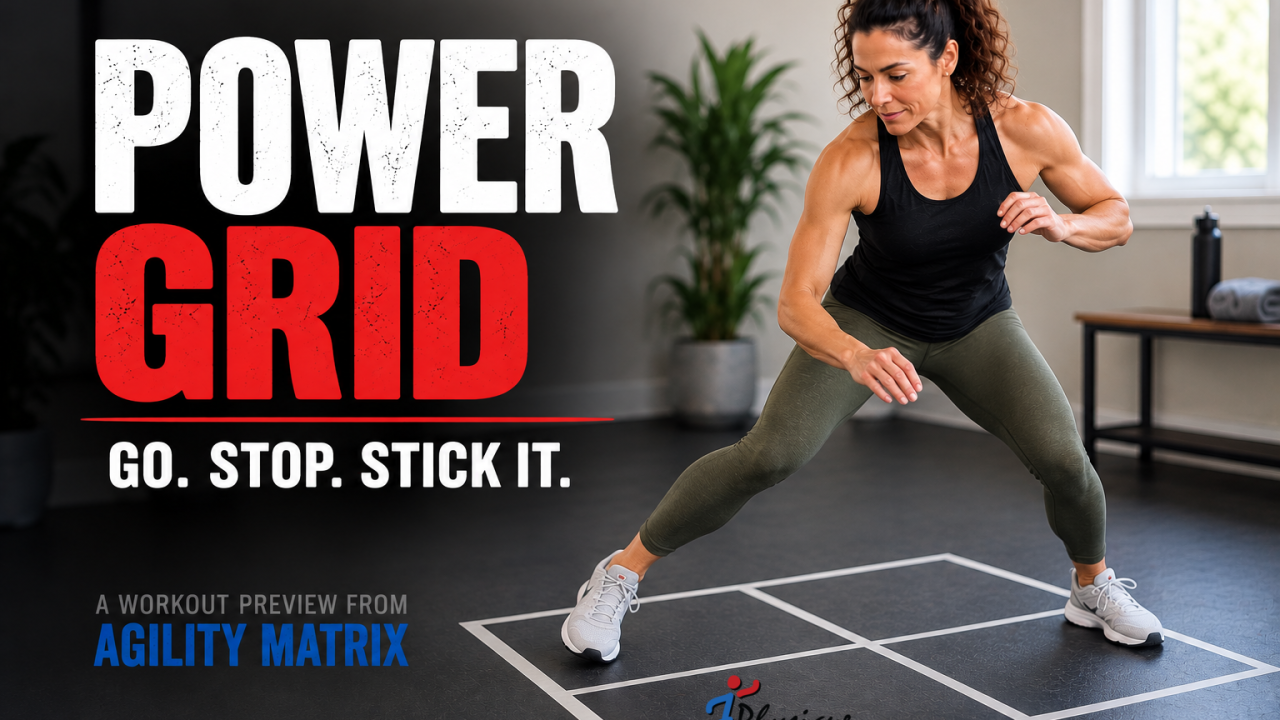
We tend to notice the beginning of movement. A Power Grid workout challenges us to pay attention to what happens at the other end, too.
We often measure progress by how quickly we can get going, how much weight we can lift, how far we can walk, or how many repetitions we can complete.
We don’t always pay as much attention to what happens at the other end.
But what happens when you need to slow yourself down? Can you stop without losing control, change direction, and regain your balance before taking the next step?
This week’s Power Grid workout preview from Agility Matrix explores that other side of movement. Coach Ro will get you moving, but the real challenge isn’t simply how quickly you can go.
It’s whether you can control what happens next.
Going and Stopping Are Part of the Same Skill
Think about how often this happens outside a workout.
You’re walking down the sidewalk and someone steps in front of you. You move quickly across the kitchen and suddenly need to avoid an open cabinet door. You step off a curb, navigate around something on the floor, or change direction because you forgot what you came into the room to get.
None of those movements ends with simply getting somewhere.
At some point, your body has to slow down, adjust its position, and become steady again.
That’s easy to overlook because stopping doesn’t look particularly impressive. But physically, it asks us to manage the momentum we’ve created rather than simply letting it carry us wherever it wants.
That takes control.
What to Expect in This Power Grid Workout Preview
This week’s Power Grid workout preview is approximately three and a half minutes long and comes from Agility Matrix, our four-week athletic-style program for everyday people.
You’ll use the familiar Matrix made from four pieces of floor-safe tape as Coach Ro introduces movement patterns built around accelerating, changing direction, slowing down, and finding control again.
You don’t need to move at Coach Ro’s speed. In fact, speed isn’t the point. Start at a pace that allows you to understand the pattern and stay in control. As the movements become more familiar, you can decide whether increasing the pace makes sense for you.
Workout Length: Approximately 3½ minutes
Equipment: Four pieces of floor-safe tape and clear space to move
Style: Agility, acceleration, deceleration, direction changes, balance, and control
The Part of Movement We Rarely Practice
Most traditional exercises have fairly predictable boundaries.
We know where a squat begins and ends and understand the path of a biceps curl. On a treadmill, we can walk forward without suddenly being asked to change direction.
There’s value in that predictability, especially when we’re learning movement or building strength. But our bodies also benefit from practicing what happens when movement becomes less predictable.
Power Grid introduces that challenge in a controlled environment.
You go. You stop. You change direction. You find your position again.
At first, those transitions may feel awkward. You might take an extra step before becoming steady or realize that stopping in one direction feels easier than another.
That isn’t something you need to hide or correct immediately.
It’s information.
Control Sometimes Begins With Slowing Down
There’s an interesting temptation when we hear the word agility: move faster.
But moving faster before you can control the movement doesn’t necessarily make you more agile. Sometimes the better progression is the opposite.
Slow down enough to understand what your body is doing.
Learn the pattern. Feel where your weight goes when you stop. Notice what happens when you change direction. Give yourself enough time to regain your balance rather than rushing into whatever comes next.
Then, if your control improves, speed can follow.
That’s a principle that extends well beyond this workout. Progress doesn’t always come from asking your body to do more. Sometimes it comes from becoming more capable with what you’re already asking it to do.
Strength Includes the Brakes
We talk a lot about developing strength to help us get out of a chair, carry groceries, climb stairs, lift things from the floor, and continue doing the activities we enjoy.
All of that matters.
But useful strength isn’t only the ability to create movement. We also need enough control to manage movement once it has started, including the balance and stability to stay in control while we’re moving.
You can think of it a little like having an accelerator and brakes. Being able to produce force is useful. Being able to manage that force matters too.
The goal isn’t to become afraid of moving quickly. It’s to develop enough control that moving, slowing down, changing direction, and becoming steady again can work together.
That’s a much broader picture of what being physically capable can mean.
This Week’s Challenge
During Power Grid, don’t make speed your first measure of success.
Pay attention to your stops.
When you change direction, can you find your balance without rushing? If you need an extra step, notice it rather than judging it. On the next repetition, see whether you can make the transition a little smoother.
You may eventually move faster.
But first, learn to own the stop.
Continue Exploring Everyday Athleticism
Power Grid is one of five workouts inside Agility Matrix, Coach Ro’s four-week program exploring speed, direction changes, reaction, coordination, balance, control, strength, and recovery through athletic-style movement designed for everyday people.
Throughout the program, the same workouts return each week. That repetition gives unfamiliar movements an opportunity to become more familiar. You may remember a pattern sooner, hesitate a little less, recover more easily after a missed cue, or find yourself moving with greater confidence.
Those changes may not look dramatic from the outside.
But they’re part of becoming more capable in the body you use every day.
Start Building Healthier Habits
Building a healthier lifestyle isn’t about pushing harder every time either. It’s about developing habits you can practice, adjust, and continue long enough for them to become part of your life.
Our Healthy Lifestyle Starter Guide can help you begin with practical approaches to movement, nutrition, hydration, sleep, and everyday wellness without trying to change everything at once.
