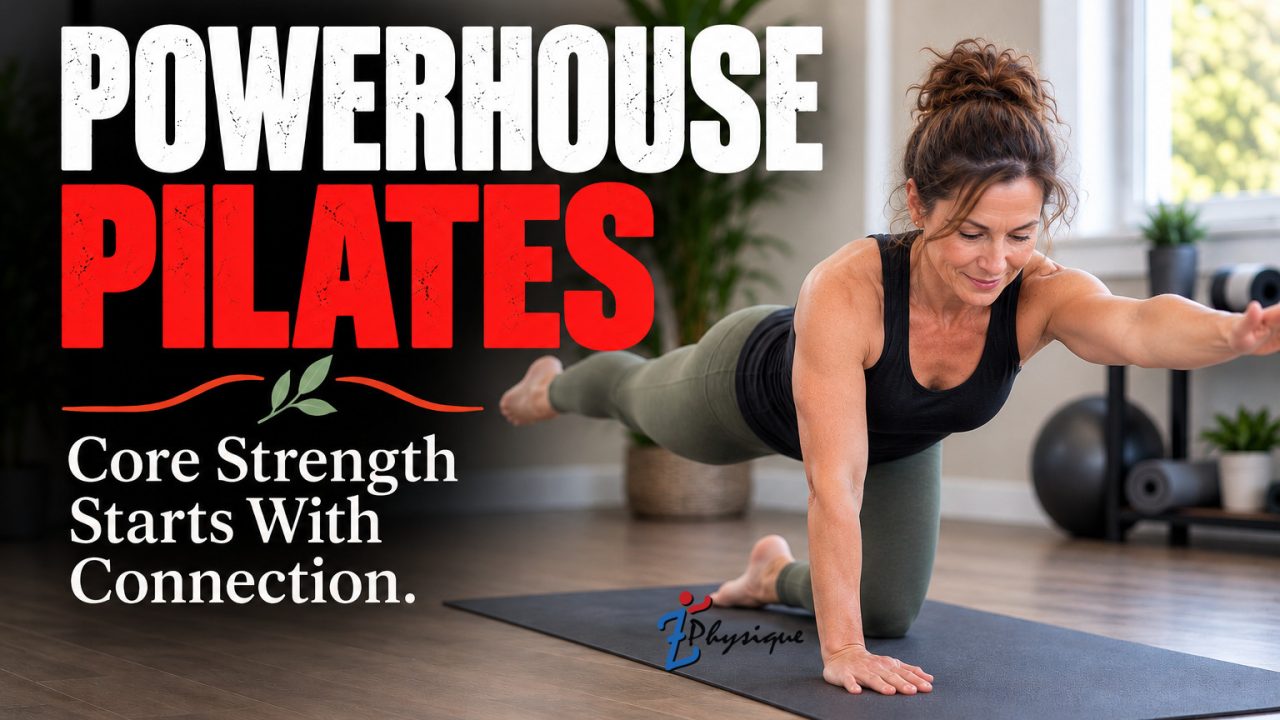
When we think about a POWERHOUSE workout designed to strengthen our core, it’s easy to think about what we can see or measure. How many repetitions can we complete, how long can we hold a plank, or how difficult can we make an abdominal exercise?
But there’s another part of core strength that’s easier to overlook: connection.
Before your arms or legs move, can you feel where that movement is coming from? Can you create a strong, supported position through your center and maintain it as the exercise changes?
That’s the idea behind this week’s POWERHOUSE workout preview—and it’s also a fitting place to begin our introduction to PILATES.
Because sometimes the first step toward moving better isn’t doing more.
It’s becoming more connected to what you’re already doing.
Your Core Is More Than Your Abs
The word core often gets reduced to the abdominal muscles, but the core extends beyond the abs, and POWERHOUSE asks us to think more broadly.
Throughout this workout, Coach Ro brings attention to the front, sides, and back of the core, along with the hips and pelvis. Together, those areas create a foundation that can support movement through the rest of the body.
That distinction matters.
Your arms and legs don’t operate independently from everything between them. When you reach, walk, carry something, change position, or get up from the floor, different parts of your body have to work together.
Core training can help us practice that connection.
And sometimes the exercise that looks fairly simple from the outside gives us the best opportunity to notice it.
What to Expect in This POWERHOUSE Workout Preview
This week’s POWERHOUSE workout preview is approximately five minutes long and comes from PILATES, Coach Ro’s new four-week Pilates-inspired program.
POWERHOUSE starts at the center. You’ll work through Pilates-inspired movements involving core connection, spinal articulation, and stability while Ro coaches you through positioning and control.
You don’t need to force a position or make a movement bigger than it needs to be. Instead, pay attention to what you’re feeling. Notice where you’re creating support, what stays stable as something else moves, and whether you can maintain that connection from the beginning of an exercise to the end.
Workout Length: Approximately 5 minutes
Equipment: Exercise mat and enough room to move comfortably
Style: Core connection, spinal articulation, stability, and controlled Pilates-inspired movement
Connection Changes the Exercise
Two people can perform what looks like the same exercise and have very different experiences.
One person may simply move a leg from one position to another. Someone else may perform that same movement while paying attention to the position of the pelvis, the support through the center, the pathway of the leg, and whether the rest of the body stays connected.
The movement may look nearly identical.
The experience isn’t.
That’s one of the ideas I like about Pilates-inspired training. The goal isn’t simply to get from the beginning of an exercise to the end. How you move between those two points matters too.
That doesn’t mean every repetition has to be perfect. It means there’s something worth paying attention to while you’re doing it.
Bigger Isn’t Automatically Better
There’s a tendency in exercise to assume that progress should always be visible.
Lift more weight. Complete more repetitions. Move through a larger range. Choose the harder variation.
Those can all be forms of progress, but they aren’t the only ones.
Sometimes a smaller movement performed with better connection gives you more useful information than a larger movement you can’t fully control. You may discover that bending your knees allows you to maintain a stronger position, or that reducing your range helps you feel the exercise where you intended.
That’s not making the workout easier just for the sake of making it easier.
It’s choosing a version that allows you to stay connected to what you’re doing.
From there, you have somewhere to build.
Paying Attention Is Part of the Work
Pilates gives us something we don’t always associate with exercise: a reason to concentrate.
Where is your pelvis? What’s happening through your spine? Are you holding your breath because you’re concentrating so hard? When your leg moves, does everything else move with it?
You don’t need to answer every question perfectly while you’re exercising. The questions themselves simply bring your attention back to your body.
Over time, movements that initially require a lot of thought may begin to feel more familiar. You spend less time figuring out where everything goes and have more opportunity to notice alignment, breathing, control, and connection.
The exercise hasn’t necessarily become different.
Your awareness of it has.
This Week’s Challenge
As you move through the POWERHOUSE workout, resist the urge to judge the experience by how hard the exercises look or how large your movements are.
Instead, choose one thing to notice.
Maybe it’s whether you can keep breathing while your core is working. Perhaps it’s what happens through your pelvis when a leg moves, or whether reducing your range helps you maintain a stronger position.
You don’t need to monitor everything at once.
Start with one connection.
Then see what you notice.
PILATES Begins Tomorrow
POWERHOUSE is the first of five workouts inside PILATES, Coach Ro’s new four-week Pilates-inspired program beginning tomorrow, October 1.
Across the program, we’ll build from the connection introduced in POWERHOUSE into CONTROL, PRECISION, FLOW, and LENGTHEN. Each workout approaches movement differently, but the same ideas continue to show up: strength, stability, mobility, balance, alignment, breath, control, and full-body connection.
You’ll return to the same five workouts each week, giving unfamiliar movements time to become familiar. As that happens, you can spend less energy wondering what comes next and more time noticing how you’re moving.
The workouts are mat-based, approximately 21–26 minutes, and Coach Ro provides options and modifications throughout so you can find the version that works best for your body.
PILATES begins October 1.
Start Building Healthier Habits
Learning to pay attention to how we move is one part of building a healthier lifestyle. The same principle can apply to nutrition, hydration, sleep, and the everyday choices that become our habits over time.
Our Healthy Lifestyle Starter Guide offers practical ways to begin building those habits without asking you to change everything at once.
