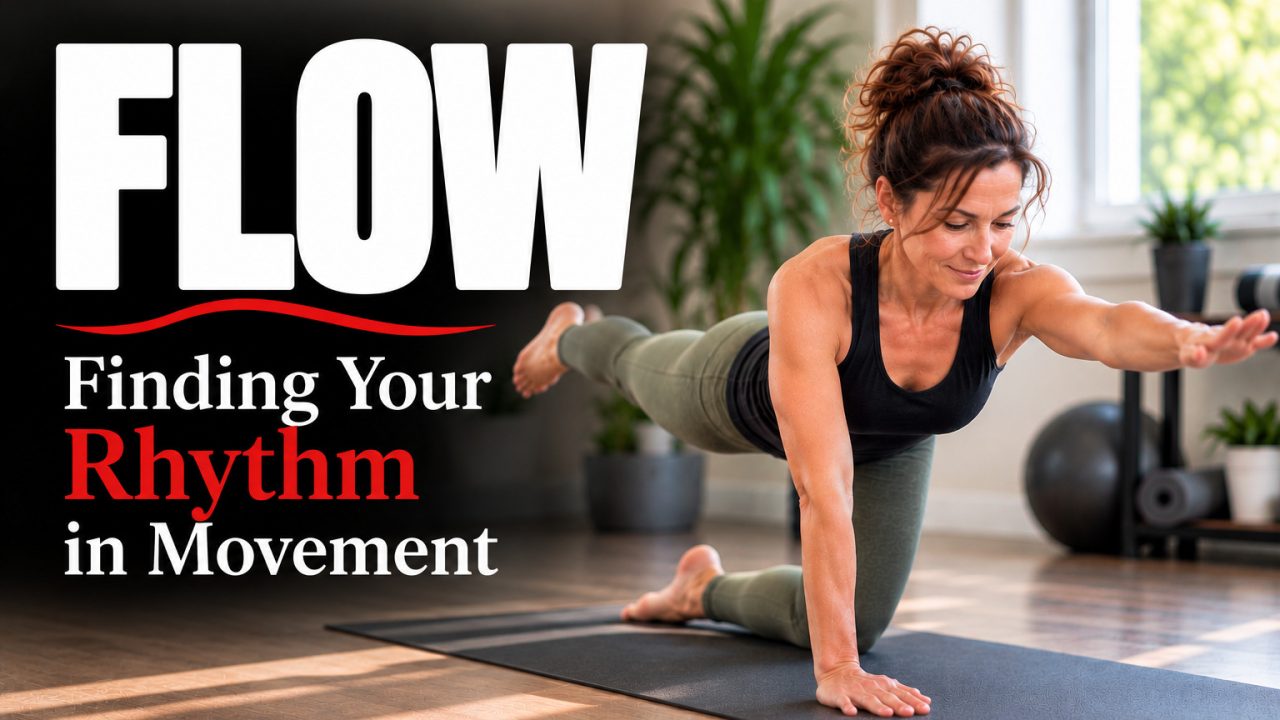
Think about learning something unfamiliar, whether it’s a new exercise, a dance step, or even a task around the house that requires a little coordination. At first, you may find yourself stopping frequently to think about what comes next. Your movements feel deliberate because you’re still figuring things out. That experience offers a useful starting point for understanding this week’s FLOW workout.
This preview from Coach Ro’s PILATES program explores what happens as individual movements begin coming together. Instead of concentrating on one position or exercise at a time, we begin paying attention to how our bodies move between them.
Eventually, some of that uncertainty begins to fade. You recognize the sequence, anticipate what comes next, and spend less time thinking about every individual step.
The movement itself may not have changed very much, but your relationship with it has.
That’s part of what makes flow worth exploring. It isn’t necessarily about moving faster or making everything look effortless. It’s about developing enough familiarity and control that one movement can lead naturally into another.
When Movement Starts to Come Together
Over the past three weeks, we’ve explored different aspects of movement through Coach Ro’s PILATES program.
POWERHOUSE introduced the importance of connecting through the center of the body. CONTROL challenged us to maintain that connection while moving our arms and legs. PRECISION encouraged us to pay closer attention to positioning, alignment, and the smaller details that influence how an exercise feels.
Each of those ideas has value on its own, but movement rarely happens in isolated pieces.
When we reach for something, step around an obstacle, or change positions, our bodies coordinate several actions at once. We shift our weight, adjust our balance, and organize our movements according to what we’re trying to accomplish.
We usually don’t stop to think about each individual adjustment. Much of it happens as part of the larger activity.
Exercise gives us an opportunity to explore those relationships more deliberately. Pilates, in particular, emphasizes controlled, flowing movement patterns alongside coordination and body awareness. We can practice the individual components, become more familiar with them, and gradually learn how they work together.
That’s where FLOW enters the picture.
What to Expect in This FLOW Workout Preview
This week’s FLOW workout preview is approximately five minutes and twenty seconds long and comes from Coach Ro’s four-week PILATES program.
The preview features Pilates-inspired mat movements that encourage you to coordinate different parts of your body while maintaining control. You’ll see Ro move through kneeling positions, controlled trunk movements, and side-supported exercises that ask you to pay attention to balance and positioning as you transition.
The emphasis isn’t on completing as many repetitions as possible. Instead, you’re encouraged to recognize how one movement connects with the next while maintaining a pace that allows you to stay comfortable and engaged.
In the full FLOW workout, this approach extends into longer sequences that bring strength, mobility, stability, and coordination together.
You don’t need previous Pilates experience to begin exploring these ideas. Adjustments to your range of motion, pace, or positioning can help you find an appropriate starting point.
Preview Length: Approximately 5 minutes, 20 seconds
Equipment: Exercise mat and enough room to move comfortably
Style: Pilates-inspired full-body movement, coordination, stability, and controlled transitions
Flow Doesn’t Mean Rushing
When we hear the word flow, it’s easy to imagine movement that looks smooth and uninterrupted. Perhaps we picture someone moving gracefully from one exercise to another without hesitating or losing their balance.
That can create an expectation that we’re supposed to keep moving, regardless of how comfortable we feel.
But moving continuously and moving well aren’t necessarily the same thing.
A brief pause may help us regain our position, while slowing down can give us time to coordinate a movement that still feels unfamiliar. Sometimes we need to make an adjustment before continuing, and that’s a reasonable part of learning.
None of those experiences means we’ve lost the purpose of the workout. In fact, learning when to slow down can be part of developing better control.
As you follow Ro through the FLOW preview, give yourself permission to move at a pace that makes sense for you. If a transition feels unfamiliar, take the time you need to understand it. If your balance changes, find your position before continuing.
The goal isn’t to keep up with every movement at any cost. It’s to begin recognizing how your body responds as one exercise leads into another.
The Space Between Exercises Matters
We often measure a workout by the exercises themselves. We think about the repetitions completed, the muscles involved, or how challenging a particular movement feels.
What happens between those exercises may receive much less attention.
Yet transitions ask something of us, too.
Moving from kneeling into a supported position, shifting weight from one side to the other, or changing the direction of a movement requires coordination. We need to recognize where our weight is supported and make adjustments as our position changes.
Those moments can be particularly revealing when we’re learning something new.
You may feel comfortable holding a position but less certain about how to enter or leave it. Perhaps one direction feels natural while the opposite direction requires more concentration.
Rather than viewing those differences as problems, we can treat them as useful information.
The transitions give us another opportunity to practice the connection, stability, and awareness we’ve been developing throughout this series. They also remind us that strength isn’t only about what we can hold or lift. Being able to move comfortably between positions is part of how we use that strength.
Finding a Rhythm That Works for You
One of the things I appreciate about this approach to exercise is that it leaves room for individual differences.
Not everyone will move through the same sequence at the same pace. Some people may feel comfortable transitioning between exercises almost immediately, while others need more time to organize their position.
Your experience may even change from one day to the next.
There may be mornings when your body feels responsive and familiar movements come easily. On another day, you might feel a little stiff, distracted, or less coordinated than usual.
That doesn’t mean you need to abandon the workout or push harder to make up for it.
You can adjust the pace, shorten the range of motion, or take an additional moment between exercises. Sometimes those small decisions allow you to participate more comfortably while still benefiting from the movement.
Finding your rhythm isn’t about matching someone else’s. It’s about recognizing what allows you to move with enough confidence and control to continue.
Familiarity Changes the Experience
Think back to the first time you tried an exercise that involved several steps.
You may have needed to watch the demonstration closely, pause to remember the sequence, or repeat part of the movement before you felt comfortable continuing.
After practicing it several times, you probably began recognizing what came next. The exercise required less conscious effort simply because it was becoming more familiar.
That process is one reason repetition has value beyond building physical strength.
Returning to familiar movements gives us opportunities to improve coordination, recognize patterns, and become more comfortable with transitions that initially felt awkward.
The PILATES program follows this principle by repeating its five guided workouts over four weeks. You’re not expected to master every movement during the first session.
Instead, you have opportunities to revisit the exercises and notice how your experience changes as you become more familiar with them.
A transition that once required a pause may eventually feel more natural. You might recognize how to position yourself before the next movement begins or discover that you can maintain your balance with less effort.
Those are meaningful forms of progress, even when the workout itself hasn’t changed.
Movement Beyond the Mat
There’s a practical side to all of this that extends beyond Pilates.
Everyday activities rarely happen as a collection of perfectly separated movements. We move from standing to sitting, bend to pick something up, turn while carrying an object, and change direction as we walk through our homes.
Each activity involves a combination of strength, balance, mobility, and coordination.
We don’t necessarily need to think about those components individually while going about our day. But becoming more comfortable with coordinated movement during exercise can help us develop skills that are relevant to everyday activities.
Consider something as ordinary as getting down onto the floor and standing back up again. It’s a sequence of movements rather than a single action. We shift our weight, change positions, use different muscles for support, and adjust our balance along the way.
Practicing controlled transitions gives us a chance to become more familiar with those demands.
The purpose isn’t to make every daily movement resemble a Pilates exercise. It’s to build physical capabilities that support the way we want to move through our lives.
This Week’s Challenge
As you follow the FLOW preview, pay particular attention to what happens between the exercises.
Notice how you shift your weight, where you place your hands or feet for support, and whether you’re giving yourself enough time to move comfortably into the next position.
Choose one transition that feels unfamiliar and approach it with curiosity. Rather than trying to complete it more quickly, see what happens when you slow down and pay attention to the movement.
You may discover that a small adjustment makes the transition feel more comfortable. Or perhaps you’ll recognize that you simply need more practice before it begins to feel natural.
Either outcome is useful.
The goal this week isn’t to create a perfectly flowing sequence. It’s to become more comfortable connecting the movements you’re learning.
Continue Exploring PILATES
FLOW is the fourth of five workouts in PILATES, Coach Ro’s four-week program designed to develop core-focused strength, stability, mobility, and full-body connection.
Throughout this series, we’ve moved from establishing core connection in POWERHOUSE to maintaining stability in CONTROL, refining movement awareness in PRECISION, and now bringing those elements together through FLOW.
Next week’s LENGTHEN workout will complete our introduction to the five sessions, with an emphasis on mobility, flexibility, and recovery.
Each full workout runs approximately 21–26 minutes, and the program includes modifications to help accommodate different experience levels and abilities.
If you’ve enjoyed exploring these movement principles through our weekly previews, the complete PILATES program offers a structured way to continue practicing them.
Start Building Healthier Habits
Developing a healthier lifestyle often follows a similar process to learning a new movement. At first, we may need to give considerable thought to choices that eventually become more familiar.
Preparing a balanced meal, making time for physical activity, or establishing a consistent bedtime routine can feel like separate tasks when we’re first getting started.
With practice, those decisions may begin fitting more naturally into our days. We become familiar with what works, recognize where adjustments are needed, and develop routines that require less planning than they once did.
Our Healthy Lifestyle Starter Guide offers practical ways to begin building sustainable habits around movement, nutrition, hydration, sleep, and everyday wellness.
